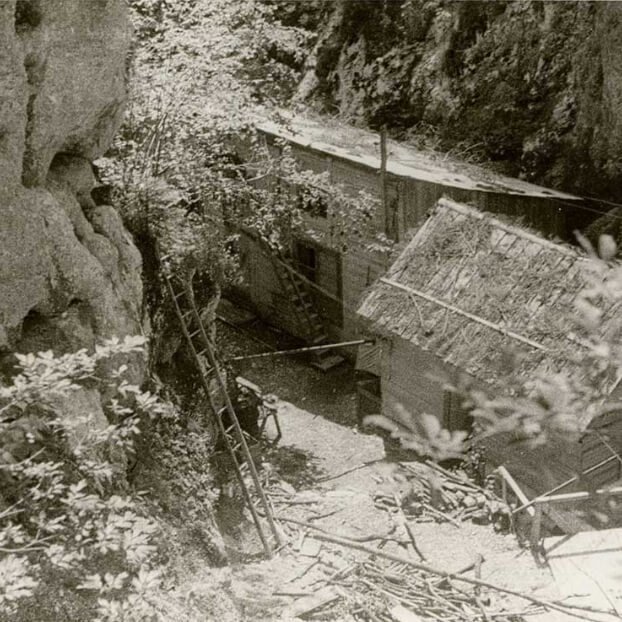
A total of over sixty people worked in all the hospital’s wards. Some were sent there from other partisan units, while others were former patients who joined its staff after recovery. Before the war, the hospital staff were engaged in various professions; most of them were workers, farmers and craftsmen, while some were students and officials. Compelled by current needs they turned into nurses, builders, stewards, etc.
Antonio Ciccarelli was born in 1914 in Novara, in the northern Italian province of Piedmont. After high school in Gorizia he completed his studies at a military academy and a medical faculty. As a young doctor he joined the army becoming a lieutenant; among other places he served was the island of Crete. He was then appointed head of the medical service at the Miren airport near Gorizia. After the capitulation of Italy in September 1943, he joined the Slovenian partisans. At the time, he was the only doctor performing surgeries behind the Gorizia frontline, although he was not qualified as a surgeon. After working in Vogrsko, in the partisan hospital led by Dr Aleksander Gala – Peter, he moved to Tratnik in Čekovnik, where the Pavla Partisan Hospital had been established. After a while, he was transferred to its ward in Jagršče. Between 1 April 1944 and 19 January 1945, he managed the Pokljuka and “Š Stol I” wards at Jelovica, which were under the administration of the Franja Partisan Hospital. After that and until the end of the war, he was head of the medical service in the Garibaldi Natisone Division, which operated within the Ninth Corps. He was constantly accompanied by Costanzo, a male nurse with whom he had established an excellent relationship. After the war he joined the Italian army, reaching the rank of General Lieutenant and becoming head of the medical unit of the military aviation. After he retired often visited Slovenia and maintained close contacts with the former hospital staff and patients he had treated. Once he was asked in an interview why he, an Italian physician, decided to remain with the Slovenian partisans after the capitulation of his country. He simply answered: “Because they kept bringing the wounded who needed my help.”